How to Avoid Instagram Community Guideline Violations in 2026
What's allowed and what isn't on Instagram in 2026 — the updated rules, the gray areas, the hidden behavior signals, and the safer alternatives that keep creators and businesses out of trouble.
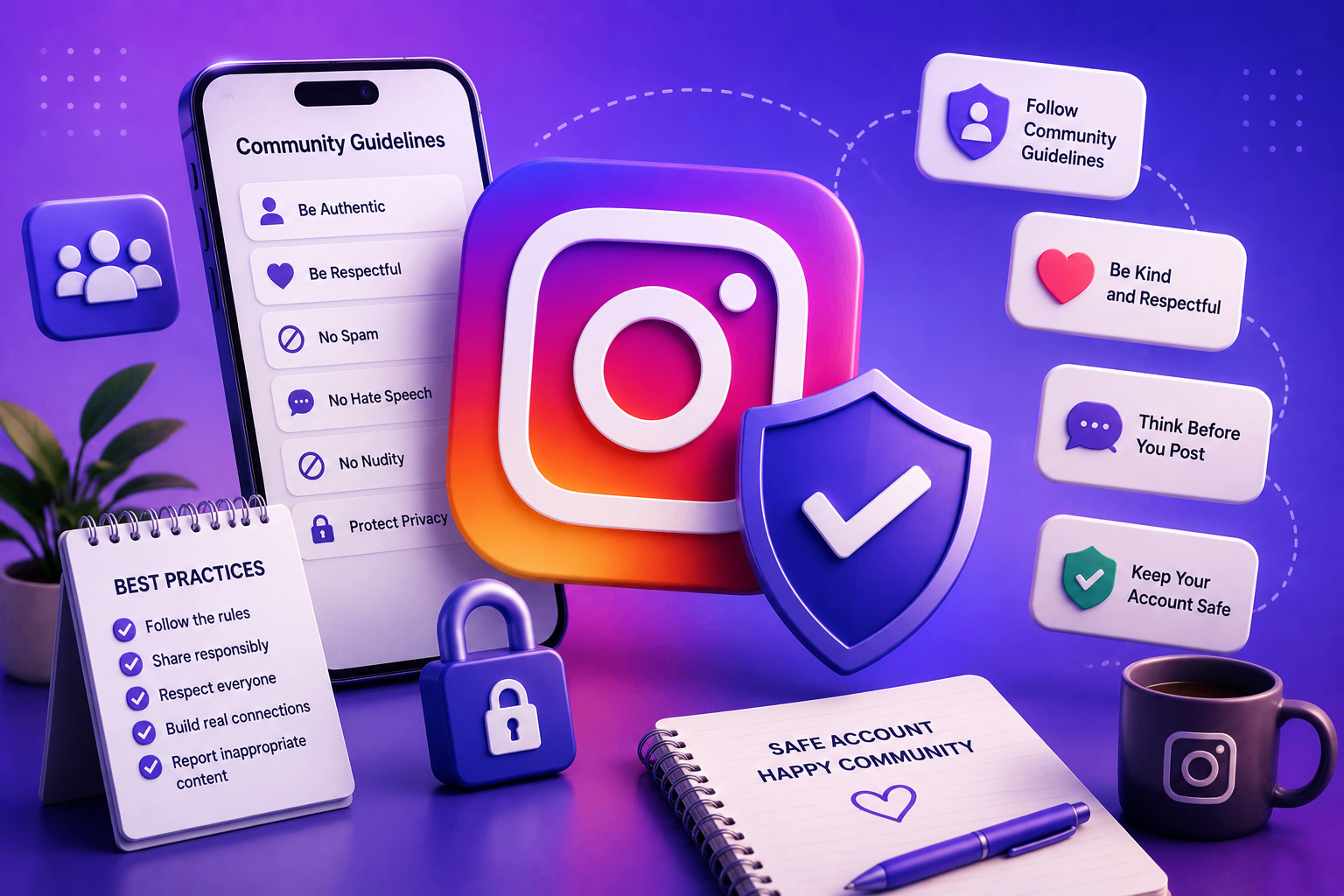
Most accounts that get disabled in 2026 are not run by bad actors — they're run by regular people and small businesses who didn't realize a small habit was a policy violation. The line between "fine" and "disabled" is often invisible until you cross it. This guide is a plain-English breakdown of what Instagram allows, what it doesn't, what's in the gray zone, and exactly which behaviors to change.
The five big policy categories
Meta groups its rules into five categories. If you stay clear of all of them, you'll almost never be disabled.
- Safety — no threats, no sexual content involving minors, no exploitation, no encouragement of self-harm.
- Voice — no hate speech, no organized harassment, no incitement to violence, no slurs targeting protected characteristics.
- Privacy — no doxxing, no sharing personal info without consent, no non-consensual intimate content.
- Authenticity — no fake accounts, no inauthentic behavior, no impersonation, no coordinated networks.
- Integrity — no fraud, no spam, no manipulation of metrics, no deceptive commerce.
Almost every disable in 2026 maps to one of these five buckets.
Hidden behavior that gets flagged (even with clean content)
Even with a perfect content history, these behaviors are commonly flagged as "inauthentic" in 2026:
- Following more than 100 accounts per hour. Genuine users rarely cross this. The classifier reads it as a growth-tool fingerprint.
- Liking faster than ~1 like per 2 seconds sustained for more than a few minutes.
- DMing many people the same message — even friends. The algorithm doesn't differentiate "spam DM" from "I'm sending the meetup address to twenty friends."
- Using emoji or character substitution to disguise banned words. It works against you, not for you — models read substitution as evasion intent and weight the violation more heavily.
- Logging in via uncommon apps that use the private (non-Graph) API. Even some popular schedulers do this.
- Repeatedly switching between personal, business, and creator account types within short windows.
- High-velocity username, bio, or email changes, especially after a password reset.
Content rules that get creators in trouble
Nudity and "sexual activity"
The 2024 update narrowed what counts as sexual activity but kept the same rules on nudity. Painting, breastfeeding, post-mastectomy, post-surgery, and historical sculpture are explicitly allowed, but they still get false-positive removed regularly. Appeals work in nearly every case where the content fits these exceptions.
For artists, the safest move is to add brief contextual captions ("oil on canvas, 2024" or "post-surgery awareness photo") so reviewers immediately see the category.
Hate speech
Slurs in 40+ languages trip the classifier. Reclaimed slurs by in-group members are technically allowed but enforcement is inconsistent — even when allowed in policy, the automated layer doesn't always respect it.
Counter-speech (quoting hate speech to refute it) is allowed but frequently mis-flagged. Add framing context in the caption.
Violence
Educational, journalistic, and counter-speech content is allowed with a warning label. Glorification of violence is not. The line is blurry and reviewers err on the side of removal. Documentary journalists, harm-reduction educators, and conflict reporters should keep proof of intent (publication links, byline) ready for fast appeals.
Misinformation
The 2026 rules limit misinformation enforcement to specific topics: elections, public-health emergencies, and content that could cause real-world harm. General opinion content, including political opinion, is allowed. Many users believe IG bans wrong opinions — it doesn't, as long as they don't fall into one of the named categories.
Commerce rules people miss
These trip more business accounts than any other category:
- No price tags on tobacco, alcohol, vaping, or weight-loss products in any market.
- No "guaranteed returns," "risk-free," or "make $X in Y days" language in finance or crypto promotion. Even legitimate marketing copy with these phrases trips the financial-promotion classifier.
- No "tag a friend to enter" giveaways in countries with stricter advertising law (EU, UK, parts of LATAM and Australia).
- No selling animals. This includes rehoming pets. A frequent surprise for shelters and breeders.
- Affiliate disclosure is mandatory for Reels and Stories. Use the paid partnership tag, not just "#ad" in text.
- No counterfeit, lookalike, or "inspired by" branded goods.
- No prescription pharmaceuticals, including supplements with drug-like claims.
- No gambling promotion outside whitelisted gambling-approved accounts.
The strike system
You get a small number of low-severity strikes (typically 4 in 60 days) before any account-level action. Severe violations (CSAM, terrorism, doxxing, non-consensual intimate content) skip the strike system entirely and disable immediately.
You can view your strikes at Settings → Account → Account Status. Check it monthly — many users discover strikes from posts they forgot about. Strikes age out after 60–90 days if no new ones are added.
Practical habits that protect you
- Slow your engagement pace. Use app timers, not third-party scripts. If you need to scale, hire human VAs and have them work from their own accounts with proper Business Suite delegation.
- Avoid logging in to your account from anyone else's phone or laptop. If you must, log out completely afterward.
- Don't share login credentials. Use Instagram's two-factor authentication and Business Suite's team collaboration features. Sharing a password is a top trigger for integrity flags.
- Read the Account Status page once a month. It tells you exactly where you stand.
- Save your posts somewhere outside Instagram. Use the data download tool quarterly. If the worst happens, you keep the work.
- Match your profile picture to your real appearance if you ever expect to do a video-selfie recovery.
- Keep the same email and phone long-term. Frequent changes are an integrity-flag trigger.
- Don't use stock or AI-generated profile photos on accounts you want to be recoverable — the face-match step won't work.
What to do if you do get a strike
A single strike is not a disable — it's a warning. The correct response is:
- Read the specific policy Meta cites.
- Decide: was the post actually against the rule? If yes, accept the strike and don't repeat the behavior. If no, appeal within 30 days through Account Status. After 30 days, the strike becomes permanent until it ages out.
- Adjust future content.
- Don't post anything in the same gray area for at least 7 days while the system re-evaluates trust signals.
Strikes age out automatically after 60–90 days if no new ones are added. Three or four within 90 days is the typical disable threshold.
Account types and their different risk profiles
- Personal accounts — lowest enforcement aggressiveness but slowest appeals.
- Creator accounts — moderate enforcement, faster appeals because of monetization ties.
- Business accounts — strictest commerce enforcement but fastest appeals.
If you sell anything, use a Business account. If you don't, use Creator if you post original content, or Personal otherwise.
When in doubt
If you're not sure whether a piece of content will trip the rules, ask our AI Case Analyzer — it can review a draft against current policy categories and warn about likely risks before you post. For specific known issues, our violation reasons guide maps symptoms to the underlying rule.
Bottom line
Staying inside the rules in 2026 is less about avoiding controversy and more about avoiding patterns that look automated or commercial when they shouldn't be. Consistent, real, human use of the app is almost never disabled. The accounts that get hit are usually doing one specific thing — a third-party tool, a fast-growth burst, a gray-area commerce post — that they could have avoided once they knew the rule.
If your account already has a strike or you've been disabled before, treat the recovery as a one-time reset. The patterns above protect new accounts and rehabilitated ones equally.