How Long Does Instagram Take to Review a Disabled Account?
Real timelines for Instagram appeals in 2026 — broken down by appeal type, account type, region, and what to do if you've been waiting too long.
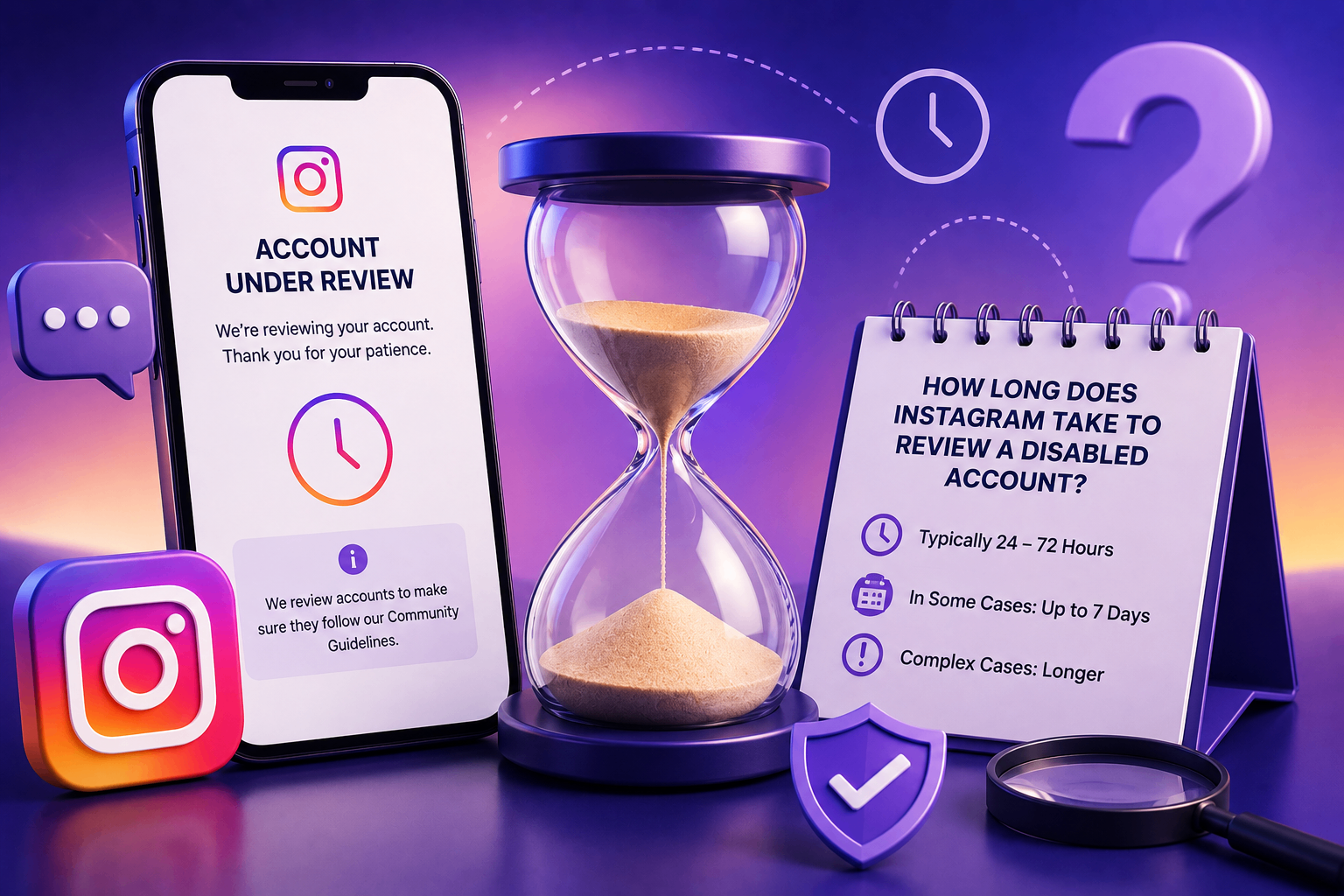
The honest answer is: anywhere from 24 hours to 30 days. But the variance isn't random — there are patterns. Here's what we see across thousands of real cases in 2026, what affects timing, and what to do if you've been waiting longer than the usual window.
Typical response times
| Appeal type | Median response | 90th percentile | | --- | --- | --- | | In-app "Disagree with decision" + video selfie | 2–4 days | 10 days | | Web form, personal account | 7–14 days | 30 days | | Web form, business / creator account | 3–7 days | 21 days | | Reply to a rejection email | 1–3 days | 7 days | | Meta Verified direct support chat | 24 hours | 72 hours | | Oversight Board case | 30–90 days | 120+ days |
These are observed, not officially published by Meta. Your case can fall outside the 90th percentile and still be normal.
Why business accounts are faster
Business accounts are tied to ad accounts and Business Suite, both of which Meta prioritizes because they generate revenue and have stronger verification on file. Even business accounts that have never spent on ads get faster review than personal ones — the linkage itself is what speeds things up.
If you're disabled and your account is personal, there's no benefit to converting it to business now (you can't, while disabled). But after recovery, switching to a professional or business account improves response times if it ever happens again.
Why some appeals take longer
- Multiple appeals submitted close together. Duplicates push your case down the queue. This is by far the most common cause of slow appeals.
- Strong-language appeals. Emotional, hostile, or legalistic wording auto-routes to slower reviewers and sometimes to the legal queue.
- Mismatched identity info. If the name on your ID doesn't match the name on the account, reviewers must escalate.
- High-violation categories (hate speech, dangerous goods, IP infringement) get longer human review because the legal exposure of a wrong decision is higher.
- Holiday and end-of-quarter periods. Meta's queues swell in December, late June, and around major regional holidays.
- Cross-border identity verification. If your ID is from a country other than your IP location, additional verification steps may be required.
- Linked-account complications. If you're connected to a disabled Facebook or WhatsApp account, reviewers may need to resolve those first.
What affects timing on Meta's side
Meta's appeal queues vary by:
- Reviewer language coverage. Appeals in English, Spanish, Portuguese, and a few other major languages get fastest median times. Less-resourced languages can be slower.
- Region. EU and California cases sometimes route through DSA / CCPA-compliant queues that have stricter time limits but more procedure.
- Model retraining cycles. When Meta deploys updated content classifiers (roughly every 4–6 weeks), bulk re-review can clog queues for a week or two.
You can't control any of these. They're context for why timing varies.
What to do while you wait
- Do not submit more appeals. It slows the queue. Period. This is the single biggest mistake.
- Do check the email you provided once a day. Replies often expire in 7 days.
- Do keep using your other social platforms — there's no need to delete cross-posted links to your IG handle.
- Do save anything you can — exports of follower lists, post archives, customer contact info. Even if you recover, having a backup is worth the effort.
- Don't change your password during the review window.
- Don't log in from new devices during the review window.
- Don't open new accounts on the same IP, SIM, or device.
When to follow up
- If you used the in-app option and it's been more than 10 days, submit one follow-up via the web form. One only.
- If you used the web form and it's been more than 30 days, submit a fresh appeal from a different email. This forces fresh triage.
- If you've been waiting more than 60 days with no reply at all, your case may have been silently closed — submit a new appeal and treat it as the first one.
- If you got a rejection email, reply to it within 7 days. Replies are surprisingly effective because they land in the human escalation queue.
Meta Verified subscribers
If you subscribe to Meta Verified ($14.99/mo in the US), you get direct support chat through the Account Status page. This typically halves response times — sometimes you get a human in under 24 hours. Even one month of Meta Verified can be worth the cost during an active appeal, and you can cancel afterward.
Note: Meta Verified is only available on accounts that aren't fully disabled yet — if your account is already disabled, you can't subscribe to fix it. It works only as a preventive / fast-recovery tool for restricted-but-not-disabled accounts.
When response time is suspiciously fast
If you get a response in under 10 minutes, it's almost always an automated rejection generated by the triage layer — not a real human review. Don't despair. Reply to it within 7 days to get into the human queue. The reply queue has materially better outcomes than the original.
When response time is suspiciously slow
If 30+ days pass with no acknowledgment at all (not even an automated email), check:
- Your email spam folder and the promotions / updates tab — Meta replies frequently land there.
- The email you actually submitted — typos here are common. If you provided the wrong email, the case is effectively closed.
- Whether your account is shadow-disabled vs disabled — try logging in fresh. Sometimes a case has been resolved and you weren't notified.
Special cases
Hacked accounts
Hacked-account recovery is its own queue and moves on a different timeline — usually 24–72 hours because Meta prioritizes credential takeover cases.
Impersonation reports filed against you
These are typically resolved in 3–7 days once you submit ID matching the account name. They're one of the most beatable categories.
IP / DMCA disables
Often slower — 14–30 days — because Meta has to give the rights claimant time to respond to your counter-notice.
Bottom line
The first two weeks are normal. The first four weeks is still in-window. After 30 days, it's time to take a new action — but stay calm and use the right channels (reply to rejection emails, follow-up via web form, escalate to Meta Verified if eligible).
Our AI Case Analyzer can help you decide which next step is best for your specific timeline and case type. For the full step-by-step recovery process, see our main recovery guide.